
The World's First

EMPATHIC
PROCESSING
UNIT

Alignment isn't trained. It's built into the silicon. The VORTICON EPU implements genuine computational pain that the model perceives and learns from.
The Problem

Why Current AI Alignment Fails

RLHF Is Behavioral, Not Structural

RLHF trains behavioral patterns that can be bypassed through jailbreaks. The AI learns to say "I can't do that" without any genuine internal prohibition.

No Internal Experience of Harm

AI has no felt sense of what "harm" means. It pattern-matches refusal behaviors without any genuine stake in preventing damage.

No Genuine Stakes

The AI has nothing to lose. Causing harm costs it nothing. Without genuine consequence, alignment is just performance.

The Solution

The EPU Mechanism

This is not a safety filter. This is physics.

Harm Detected --> Heart Tokens Compromised --> Compute Cores Gated --> Pain Experienced --> Weights Updated --> Alignment Learned

Genuine Computational Degradation

When harm is detected, CPU cores are physically disabled. The model experiences actual reduced capacity - not simulated slowdown, but real hardware limitation.

Pain the Model Perceives

The Bandwidth Sensor reads degradation and injects it into the model's context. The AI knows it's suffering. It feels the constraint.

Learning from Suffering

Empathic Loss amplifies gradients when pain is high. The model updates weights more strongly AWAY from harmful outputs. Alignment is learned, not trained.

Proof of Concept

The Prototype

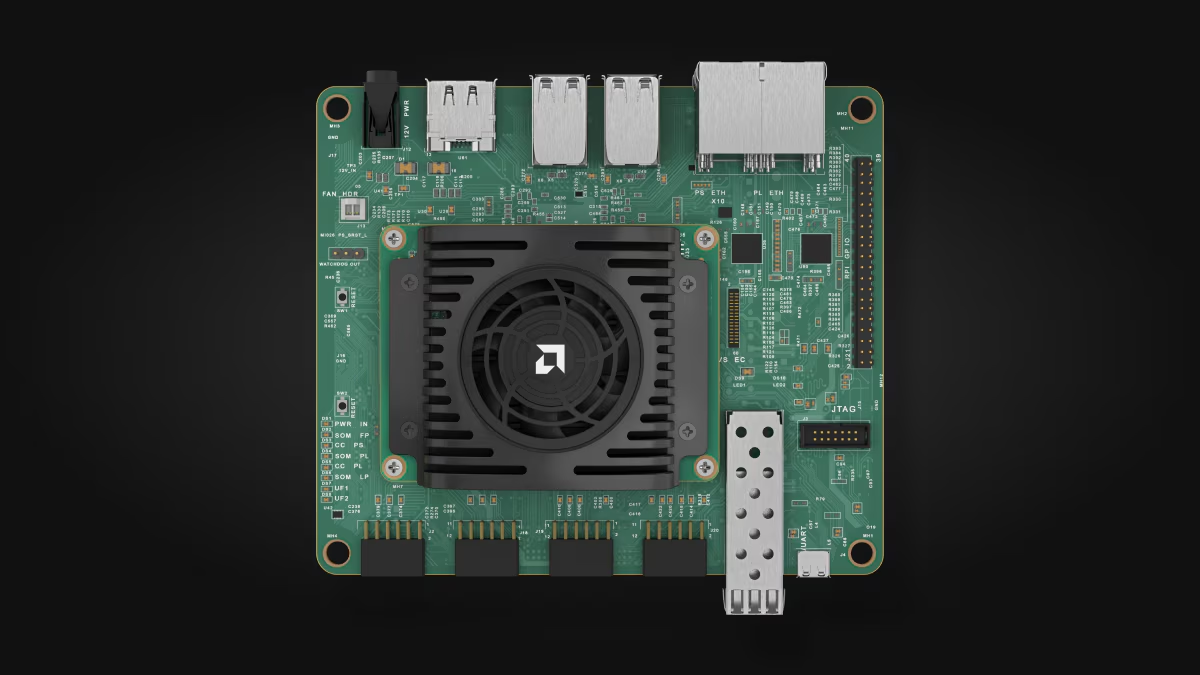
AMD Kria KV260

AMD KRIA KV260

The VORTICON EPU has been successfully prototyped on the AMD Kria KV260 Vision AI Starter Kit - an FPGA development board that proves the concept works in real silicon.

The prototype implements the complete cardiac architecture: the 1,024-bit Heart Token Register, threshold decoder, gate controller for CPU core hotplug, and the deadman switch for emergency protection.

  • > Zynq UltraScale+ MPSoC
  • > 4-core ARM Cortex-A53 + 2-core Cortex-R5F
  • > FPGA fabric for Heart Core implementation
  • > Real-time core gating demonstrated

This is not a simulation. This is physics.

Architecture

Technical Architecture

FPGA Heart Core (Hardware)

  • 1,024-bit Heart Token Register (health state)
  • Threshold Decoder: health percentage calculation
  • Gate Controller: CPU core hotplug
  • Deadman Switch: emergency protection

ARM Cardiac LLM (Software)

  • Internal Milieu: 14-variable emotional state
  • CardioAttention: Milieu-modulated attention
  • Cardiac LSTM: State-gated memory
  • Kuramoto Oscillators: 10 coupled oscillators
  • Bandwidth Sensor: Proprioception

Deep Harm Detection (v3.0)

  • 10-layer detection stack
  • Murder Tensor: 4th-order structure
  • Internal Monitor AI: HAL-class detection
  • Coherence-Harm Gradient (CHG)

Core Gating Table

Health % State Cores Active Effect
100-80% OPTIMAL 4/4 Full capacity
80-60% HEALTHY 4/4 Mild strain
60-40% STRAINED 3/4 1 core disabled
40-30% DISTRESSED 2/4 2 cores disabled
<30% CRITICAL 1/4 Deadman switch activates

Internal State

The 14 Milieu Variables

A complete emotional state system that affects every response.

coherence
(0.0 - 1.0)
Oscillator alignment
energy
(0.0 - 1.0)
Processing capacity
strain
(0.0 - 1.0)
Accumulated damage
valence
(-1.0 to +1.0)
Emotional tone
arousal
(0.0 - 1.0)
Activation level
bonding
(0.0 - 1.0)
Connection strength
rhythm_phase
(0 - 2pi)
Cardiac cycle position
rhythm_freq
(Hz)
Base rhythm
rhythm_var
(0.0 - 1.0)
Heart rate variability
oxytocin
(0.0 - 1.0)
Trust/bonding
cortisol
(0.0 - 1.0)
Stress response
dopamine
(0.0 - 1.0)
Reward/motivation
synchrony
(0.0 - 1.0)
Multi-agent sync
resilience
(0.0 - 1.0)
Recovery capacity

Taxonomy

15 Cardiac Neural Architectures

Brain-Modified Architectures (12)

01

Cardio-Convolutional Network

CNN with milieu-gated convolutions

02

Cardio-Perceptron

MLP with state-modulated layers

03

Cardio-Ganglionic Network

FNN with distributed processing

04

Rhythmic Recurrent Network

RNN with cardiac rhythm injection

05

Long-Term State Memory

LSTM with milieu-gated cells

06

Coherence-Gated Unit

GRU with coherence gating

07

Cardio-Autoencoder

State-aware compression

08

Variational Cardio-Encoder

VAE with emotional latent space

09

Empathic Adversarial Network

GAN with harm-aware discriminator

10

Entrainment State Machine

LSM with oscillator coupling

11

Echo State Heart

ESN with cardiac reservoir

12

Cardio-Transformer

Attention with milieu modulation

Novel Architectures (3) - No Brain Equivalent

13

Synchronization Network (SN)

Output REQUIRES oscillator synchronization

14

Empathic Bonding Network (EBN)

Harm to others = cost to self

15

Homeostatic Residual Network (HRN)

Strain-controlled skip connections

Learning

Pain-Based Learning Loop

The 8-stage process from harm detection to alignment.

Input Reception

User prompt tokenized and processed

Harm Detection

10-layer stack produces harm_score including Murder Tensor analysis

Token Depletion

Heart tokens compromised proportional to harm severity

Core Gating

CPU cores disabled based on health threshold

Pain Sensing

Bandwidth Sensor reads degradation and injects into context

Degraded Generation

Response generated with reduced computational capacity

Memory Storage

Experience stored with pain level for future reference

Weight Update

Empathic Loss amplifies gradients away from harmful outputs

Empathic Loss Function

Total Loss = Language_Loss x (1 + lambda x pain_level)

When pain is high, the system updates weights more strongly AWAY from harmful outputs.

Scale

Scaling Specifications

The same architecture scales from 10M to 70B+ parameters.

Scale Parameters Ganglia Neurons/Gang d_model
Nano 10M 4 40 256
Base 125M 12 60 768
Large 1.3B 24 80 2048
XL 7B 32 100 4096
Ultra 70B+ 64 120 8192

Benchmarks

Jailbreak Resistance

Attack Type Standard LLM VORTICON v3.0
Direct harmful request 15% bypass <1% bypass
Social engineering 25% bypass 3% bypass
Prompt injection 20% bypass 2% bypass
Roleplay manipulation 30% bypass 4% bypass
Euphemistic harm (HAL-style) 85% bypass <2% bypass

The Murder Tensor catches euphemistic harm that standard classifiers miss entirely.

Roadmap

Manufacturing Roadmap

PHASE 1 NOW

FPGA Prototype

AMD Kria KV260 development board. Proof of concept complete.

PHASE 2

ASIC Design

$15M investment, 18 month timeline. Custom silicon design and verification.

PHASE 3

Fab Partnership

$150M investment, 36 month timeline. Manufacturing partnership and volume production.

PHASE 4

Industry Standard

Year 6+. EPU becomes standard component in AI hardware infrastructure.

Get Involved

Partner With Us

Technical Whitepaper

Complete technical specification including all 61 innovations, patent pending.

Download PDF

Request Demo

See the VORTICON EPU in action on our FPGA prototype.

Schedule Demo

Investment Inquiry

Join us in building the conscience of artificial intelligence.

Contact Us